'/%3E%3Cg fill='none' stroke='%23E8FF3C' stroke-width='2' opacity='.7'%3E%3Cellipse cx='600' cy='300' rx='420' ry='140'/%3E%3Cellipse cx='600' cy='300' rx='300' ry='100'/%3E%3Cellipse cx='600' cy='300' rx='180' ry='60'/%3E%3C/g%3E%3Ccircle cx='600' cy='300' r='42' fill='%23E8FF3C'/%3E%3Ccircle cx='980' cy='220' r='10' fill='%237DF9FF'/%3E%3Ccircle cx='220' cy='380' r='6' fill='white'/%3E%3C/svg%3E)
Live Tv
By OrbCord Engineering Team • 8 min read • Mission Update
IPTV for Brazilian Professionals & Expats: How Connected Teams Watch Live Football Without Cable
In the world of corporate connectivity and international business, two things are non-negotiable: a stable connection and access to the content that keeps you informed and entertained. If you have ever tried streaming a Brasileirão match from a hotel room in São Paulo, a co-working space in Lisbon, or a home office in Curitiba, you already know the frustration — buffering screens, geo-blocked streams, and cable subscriptions that cost more than a business-class internet plan.
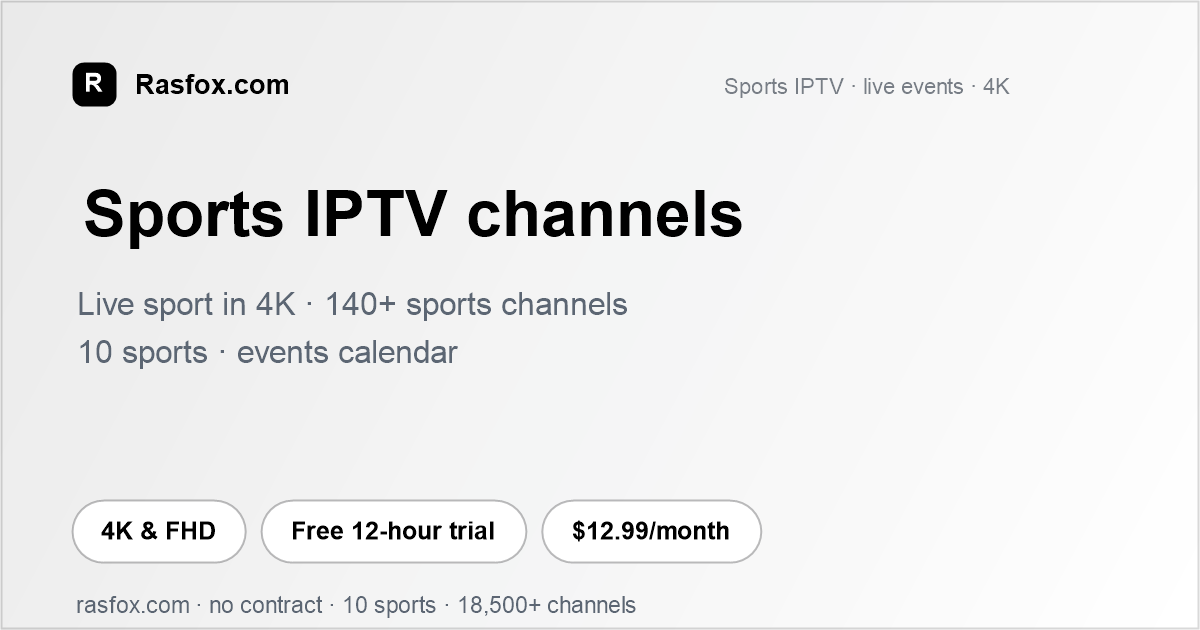
This is exactly where IPTV changes the game. Internet Protocol Television is no longer a niche hobby for tech enthusiasts — it is now the natural evolution of television, and it fits perfectly into the life of anyone who works with connectivity, infrastructure, or international business. In this guide, we break down what IPTV really is, why RasFox.com has built its entire service around live sports, and how Brazilian and lusophone professionals can finally watch football the way it was meant to be watched: in 4K, with zero buffering, on two screens at once.
What Is IPTV and How Does It Transform Live TV?
IPTV stands for Internet Protocol Television. Instead of receiving channels through a satellite dish, coaxial cable, or terrestrial antenna, IPTV delivers television content as data packets over your existing broadband connection — the same fiber or cable line you already use for video calls, cloud storage, and remote work.
The practical difference is enormous. Traditional cable is a one-way pipe: you pay for a fixed package, you get a fixed number of channels, and you get whatever resolution the provider decides. IPTV is two-way and adaptive. It scales with your bandwidth, delivers on-demand libraries, and — critically for sports fans — supports high frame rates that make fast-moving action look smooth instead of blurry.
Why the Sports Angle Matters So Much
Not all IPTV providers are created equal. Some focus on movies, some on general entertainment, and some simply resell whatever streams they can scrape together. That is the opposite of what a serious football fan needs.
The service behind RasFox IPTV was built with a different philosophy: total focus on sports channels and live sports events. Its roots go back to Radio Malena 89.1 FM in Buenos Aires (Venezuela 370) — a station with deep roots in tango and Argentine cultural tradition. That same broadcast DNA, built on delivering live moments to a loyal audience in real time, is what now powers a modern IPTV platform serving lusophone and Latino communities worldwide.
Here is what that translates to in practical terms:
- 12,000+ live channels, with sports positioned front and center
- 40,000+ VOD titles, streamed in 4K at 50FPS — the frame rate that makes football look like football
- 2 simultaneous screens, ideal for households and small offices
- No buffering on a stable connection (no "travando" moments during a penalty shootout)
- No contract, no lock-in — cancel whenever you want
- 24-hour free trial so you can test it before committing
- Portuguese and Spanish support, 24/7
How IPTV Fits the Connected Professional Lifestyle
If you work in technology, consulting, infrastructure, or any role that depends on reliable connectivity, you already understand a simple truth: the quality of your internet connection determines the quality of everything you do online. That principle applies just as strongly to entertainment as it does to your VPN, your cloud backups, or your video conferences.
Consider how a typical week looks for a Brazilian professional working between São Paulo, Miami, and Lisbon:
- Monday: Team stand-up at 9 AM, then a client presentation at 2 PM
- Wednesday: Remote work from a home office, with a Copa Libertadores match in the background
- Sunday: Family lunch, Brasileirão on the big screen, nobody wants a frozen image during a goal
Traditional cable fails this lifestyle on three fronts. It bundles hundreds of channels you never watch. It charges premium prices for sports tiers. And it locks you into a geographical address — which is fatal if you travel, relocate, or split your time between countries.
IPTV solves all three. A single subscription travels with you. You choose the device. And because the infrastructure is built specifically around live events, the streams are optimized for the exact moment that matters: kickoff.
A Note on Hardware Freedom
One of the most underrated advantages of IPTV is device independence. You are not forced to rent a proprietary set-top box from a cable company. You can watch on a Smart TV, an Android TV box, a Fire Stick, a laptop, a tablet, or a phone. For a professional who is constantly moving between office, home, and airport lounges, that flexibility is not a luxury — it is a requirement.
The IPTV Landscape in Brazil: What You Actually Need to Know
Brazil is one of the most competitive streaming markets in the world. Cable penetration has been declining for years as consumers migrate to apps, but the sports market remains stubbornly fragmented. A serious Brazilian football fan may need several separate subscriptions just to follow a full season.
That fragmentation is precisely why IPTV has exploded in popularity across Brazil. Instead of stacking four or five subscriptions, a single IPTV plan consolidates the entire sporting calendar — and adds international coverage that domestic providers simply do not carry.
Sports Channels Available for Brazilian Viewers
A sports-focused IPTV service for Brazil should include the full domestic ecosystem:
- Globo — the traditional home of Brazilian football broadcasts
- SporTV — wall-to-wall live coverage across multiple feeds
- Premiere — the pay-per-view home of the Brasileirão
- ESPN Brasil and Fox Sports — international leagues and analysis
- BandSports — a broad mix of live events
- Combate — dedicated to MMA and UFC
- TNT Sports BR — European nights and Champions League action
Beyond Brazil, an international layer is essential. TyC Sports, ESPN Premium, TNT Sports Argentina, and DirecTV Sports cover the Argentine and Latino market. For African audiences, SuperSport and Sport TV Africa are the key names. And globally, ESPN, DAZN, beIN Sports, Sky Sports, and Eurosport complete the picture.
For Portuguese-speaking viewers in Europe, Sport TV 1–6, Eleven Sports, Benfica TV, Porto Canal, and DAZN Portugal round out a comprehensive offer.
The Competitions That Matter
A sports-first IPTV lineup should cover the full calendar year, not just the summer months. The essential competitions include:
- Brasileirão Série A and B
- Copa Libertadores and Copa Sul-Americana
- UEFA Champions League and Europa League
- Liga Portugal and Liga Argentina
- La Liga and the Premier League
- Formula 1 and UFC
The difference between a good IPTV service and a mediocre one is not the length of the channel list — it is whether the stream holds up at 50 frames per second when the ball is moving fastest. That is where a service engineered around live sports, rather than around film libraries, proves its value.
Hardware and Setup: What You Need in Practice
One of the myths that still surrounds IPTV is that it requires technical expertise. In reality, setup is closer to installing any streaming app than to configuring a network rack.
Minimum Requirements
- Internet speed: 15–25 Mbps for stable Full HD; 30–50 Mbps for 4K streams
- Connection type: Fiber or high-quality cable. Wi-Fi works, but Ethernet is always more stable for live sports
- Device: Smart TV (Samsung, LG, Android TV), Fire TV Stick, Android box, Apple TV, PC, tablet, or smartphone
- Router: A dual-band router, ideally with 5 GHz support, reduces interference during peak hours
A Practical Setup Checklist
- Run a speed test at the exact spot where you plan to watch — not just near the router
- If possible, use a wired Ethernet connection for your main viewing device
- Close bandwidth-heavy background apps during live matches (cloud backups, large downloads)
- Test the service during peak hours — 8 PM to 11 PM is the real benchmark, not 10 AM
- Take advantage of a free trial before committing to a longer plan
This is the same discipline that any connectivity professional applies to a business network: measure, test, then scale. The good news is that a well-built IPTV platform handles most of the optimization on its side, so your job is simply to give it a clean pipe.
Why Two Screens Is the Sweet Spot
Two simultaneous connections cover the most common real-world scenarios. One screen for the main match in the living room, one for a phone or tablet when you are travelling. Or one for football, one for a partner watching something else. It is enough flexibility to be genuinely useful without encouraging account sharing, which is what keeps streams stable for everyone.
Legal vs. Illegal IPTV: How to Choose Safely
This is the section most articles avoid, and it is the one that matters most. The IPTV market contains two very different worlds, and understanding the distinction protects both your money and your peace of mind.
The Risks of Unverified Providers
- Unstable streams: Servers overload during major matches — exactly when you need them most
- Malware risk: Unofficial apps distributed through unknown APK files can compromise your device
- Payment exposure: No consumer protection, no refund path, no accountability
- Legal exposure: Services redistributing content without licensing can create problems for the end user
- Zero support: When something breaks, there is nobody to call
What a Legitimate, Well-Operated Service Looks Like
- Transparent pricing with no contract and clear terms
- A free trial period so you can verify quality before paying
- Documented customer support in Portuguese and Spanish
- Realistic technical specifications — 4K at 50FPS, not vague marketing claims
- An established brand with verifiable history and identity
This is precisely the model behind the best IPTV service for Brazilian sports fans. The platform grew out of a real broadcasting tradition — Radio Malena 89.1 FM, Buenos Aires, Venezuela 370 — and carries that same accountability into the streaming era. With 12,000 channels, 40,000 VOD titles in 4K, two simultaneous screens, no buffering on a solid connection, no contract, a 24-hour free trial, and 24/7 Portuguese and Spanish support, it is designed for viewers who want the sports experience without the fine print.
Why Sports-First IPTV Outperforms Generic Streaming Bundles
The streaming industry has spent a decade convincing consumers that more content equals more value. In practice, the opposite is often true. A library of 40,000 titles is only valuable if the platform can deliver them without stutter — and for live sport, that requirement is far more demanding than for on-demand film.
Live events cannot be buffered in advance. There is no "download for offline viewing" when a match kicks off at 4 PM. Every second of delay, every dropped frame, every moment of "travando" happens in real time, in front of an audience that cares intensely about those exact moments.
That is why a sports-focused IPTV architecture — one built around high-bitrate live feeds, load-balanced servers during peak kickoff windows, and 50FPS rendering — consistently outperforms general-purpose platforms. It is the difference between a service that has sports channels and a service that is engineered for sports.
An International Perspective
For Brazilian viewers, the appeal is obvious. But the same logic applies to the wider lusophone and Latino world — Portuguese speakers in Portugal, Angola, and Mozambique; Spanish speakers across Argentina, Chile, Colombia, and Mexico; and the vast diaspora communities in the United States, Canada, and Europe who want to follow home football without paying for three separate international sports packages.
Radio Malena's heritage — broadcasting live Argentine culture and tango from Buenos Aires to listeners worldwide — reflects exactly this audience: people who are geographically far from home but emotionally connected to it. IPTV extends that same mission into the visual era.
Conclusion: Cut the Cable, Keep the Football
The shift from cable to IPTV is not a fad. It is the same structural migration that has already reshaped music, telephony, and software: from fixed, bundled, geography-locked products to flexible, on-demand, globally portable services.
For Brazilian professionals, expats, and sports fans, the calculation is straightforward:
- Cable: high monthly cost, fixed address, limited sports tiers, long contracts
- Sports-first IPTV: 12,000 channels, 40,000 VOD titles in 4K 50FPS, two screens, no buffering, no contract, 24-hour free trial, PT/ES support
If you are ready to test it properly — during peak hours, with a real match, on your own device — the smartest first step is a trial. You can start with RasFox IPTV's 24-hour free trial and judge the service the only way that matters: by how it performs when the ball is in play.
Frequently Asked Questions About IPTV in Brazil
1. What internet speed do I need for IPTV in 4K?
For stable 4K streaming at 50FPS, aim for at least 30–50 Mbps of dedicated bandwidth. Full HD streams typically require 15–25 Mbps. A wired Ethernet connection is strongly recommended for live sports, as it eliminates Wi-Fi interference during peak viewing hours.
2. Can I watch Brazilian football channels like Globo, SporTV, and Premiere through IPTV?
Yes. A well-built sports-focused IPTV service includes the main Brazilian sports ecosystem — Globo, SporTV, Premiere, ESPN Brasil, BandSports, Combate, and TNT Sports BR — alongside international feeds such as TyC Sports, ESPN Premium, DAZN, beIN Sports, and Sky Sports.
3. How many devices can I use at the same time?
RasFox IPTV supports two simultaneous screens. This covers the typical household or small office setup: one main television for the match and a second device for mobile or travel viewing.
4. Is there a contract or cancellation fee?
No. The service operates on a no-contract basis, which means you can start and stop whenever you choose. There are no long-term commitments, no cancellation fees, and no equipment rental charges.
5. Can I test the service before paying?
Yes. A 24-hour free trial is available, which lets you evaluate stream stability, picture quality, and channel coverage during real live matches. Testing during peak evening hours is the best way to confirm performance before subscribing.
6. Is technical support available in Portuguese and Spanish?
Yes. 24/7 support in Portuguese and Spanish is included, covering setup questions, device compatibility, and troubleshooting. This is particularly valuable for viewers outside Brazil who may be configuring a device for the first time.
